


3 ways to beat social anxiety
- Oct 17, 2024
- 5 min read
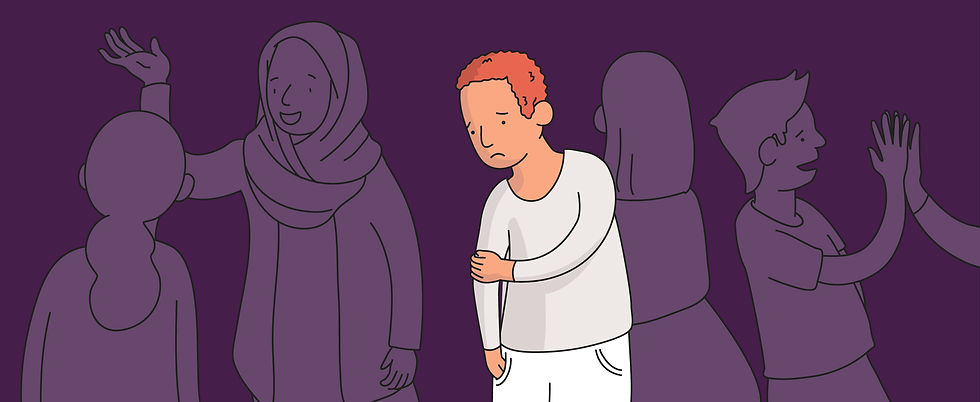
Hey everyone, today we're going to talk about three CBT (cognitive behavioral therapy) techniques that can help you overcome social anxiety. First, let's define the term anxiety. Anxiety is a feeling of worry, nervousness, or unease, typically about an imminent event or something with an uncertain outcome. Now, when we talk about social anxiety, that worry or nervousness is focused primarily on social interactions, and to specifically target social anxiety, we have to understand anxiety as a whole.
What is Social Anxiety
Anxiety is created and sustained by three different components. The physiological component, cognitive, and behavioral. Now, the physiological part is how anxiety feels in our body. Could be a racing heart, sweaty palms, flushed face, or even feeling faint, and this is one of the most important components of anxiety because it's the first one people notice.
If you suffer from panic attacks, those symptoms would fall under this portion. The second is the cognitive part. Now, cognitive is, honestly, it's just a fancy way of saying thoughts or thought processes. Any anxious thoughts that we have would fall into this category.
Many of my patients report thinking, "I'm gonna make a fool of myself," or, "Ugh, they'll just think that I'm so boring." So, any prediction that comes out of our anxiety would be considered part of the cognitive portion. And the third is the behavioral part. For something to be part of this component, it needs to be something that someone else could notice us doing or not doing. Could be not making eye contact, looking away, stuttering, or even walking quickly by. This could also be something we aren't doing because we're avoiding it completely, but someone would still notice that we didn't go to lunch with the team like everyone else, therefore avoiding something because of our anxiety would still fall under this category. Now, most people with social anxiety don't just experience one of these components. These three parts usually work together to intensify our anxiety episodes. For example, let's just say that your boss comes over to your desk and says that they would like
to see you after lunch. You could automatically think that you must have done something wrong or that you're, you know, in really big trouble for something. Then, you begin to feel your muscles tighten, your heart starts to race, and you begin to sweat. Then, you may dread going in to see them in their office, trying to put it off as long as you can, or even struggle to make eye contact once you get in there. So, you can see, just based on that simple example,
how all three components almost happen automatically when we struggle with anxiety.
Systemic Graduated Exposure
Therefore, to overcome our social anxiety, we're gonna have to fight back against all three of them, and the first step to fighting back is doing systemic graduated exposure, which is honestly just another fancy way of saying that we're going to have to slowly expose ourselves to the scary or anxiety-provoking thing until it's no longer so scary or anxiety-provoking. Now, I've talked about exposure therapy in the past and this is very similar. However, it is specific to social anxiety and its treatment and this type of exposure therapy must be done with a mental health professional so that we can role-play different scenarios in session and get feedback on how it went. It also allows us to play out any situations or circumstances that we're afraid will happen when we try to do this outside of therapy.
This type of treatment works so well because it allows us to practice exactly what it is that we need or want to do, and we get to say what it is that we need to say and imagine what someone else would say back, and then we get feedback immediately after about how it went. It also works because it gives you the time you need to see that any of the bodily responses you're having to the anxiety, like shaky knees, and a racing heart, all will go away after a while.
As long as we're to stay in the anxiety-provoking situation, 'cause let's be honest, we usually don't, right? Instead, we assume that we'll have felt terrible and anxious forever if we didn't run away or find a way to leave immediately. But, staying in it, we can realize that our feelings of anxiety only last for a little bit, and the more we practice it and expose ourselves to those anxious experiences, the better it gets. Also, by role-playing an anxiety-provoking situation in therapy, we can test out any of our dysfunctional beliefs, meaning that if we worry that when we stand up and give a presentation at work, we're gonna sneeze and spit all over our boss and have to walk out in shame. We can practice giving our presentation, pretending that our therapist is our boss, and see just how unlikely that scenario is.
It's sort of another way of testing our anxious beliefs to show us just how faulty they are.
Step number two is cognitive restructuring, which is just another fancy saying, but it means that we are going to safely question any beliefs, assumptions, or expectations that we have.
Just like I mentioned before, we may believe that when we give our presentation, we're gonna sneeze on our boss and we have to walk out in shame. This portion of treatment helps us acknowledge that expectation and learn to healthfully question it. Just like I said before if we're role-playing, we can see just how unlikely it is that that's gonna happen, and part of that is kinda the cognitive restructuring. Now, how this would work in therapy is that you and your therapist will begin noticing any beliefs, assumptions, or expectations that you have that may be false or only make your anxiety worse. You know, bringing these up in session and working together to question them to see if they make sense or are helpful in your life.
Now, I know this can sound intense and terrifying, but know that all of this is done slowly and with care. As you role-play different anxiety-producing social situations, you can assess all of this. You can even start today, honestly, by simply noticing what it is you're worried will happen if you do the thing you feel anxious about. By taking the time to question those beliefs or the thoughts that come up, we're not only changing and challenging the cognitive component of anxiety, but we're also decreasing the avoidance or behavioral component, so it's kinda like a two-in-one. The third and final tip is to practice in real life. Every social anxiety treatment is going to involve some homework outside of therapy because just practicing things in therapy isn't going to make doing it in real life any easier. We have to push ourselves to try new things out and report back how it went. This homework could also include just keeping track of our anxious or dysfunctional thoughts, maybe reading certain books or working in a workbook, but it will need to be done outside of your therapy sessions, and it's really important to remember to be honest with your therapist during this part of your work together because we need to let them know what we'll be able to do or not do. It doesn't help us to just say, "Yes, I'm gonna do all this homework, this is fine," if we aren't gonna be able to follow through. So, if you feel that they're going too fast or pushing you too hard, let them know, and speak up, and just by doing that, you're already practicing being assertive and speaking up for yourself.
3 ways to beat social anxiety


Comments